Table of contents



Your website should be one of your most valuable business assets. It should attract qualified visitors, communicate your value clearly, generate leads, and support long-term growth. Yet many businesses continue operating with an outdated website without realizing how much revenue and opportunity they are quietly losing.
The impact can be significant. After launching a redesigned website and implementing an SEO-focused growth strategy, Speech Therapy PD increased conversions by more than 300% within the first year. While every business is different, results like these highlight how much untapped potential can exist when a website is no longer aligned with business goals.
An outdated website does not need to be broken to create problems. In many cases, it functions well enough to avoid immediate concern while slowly reducing visibility, hurting conversions, creating friction for customers, and limiting growth.
In this guide, we’ll explore the real cost of an outdated website, the business impact it creates, and how organizations can identify and recover lost opportunities.
Most businesses evaluate website performance based on obvious issues. If the site loads, the contact form works, and visitors can access information, everything appears fine.
The reality is more complicated.
Revenue loss from an outdated website typically happens gradually. Visitors leave before converting. Prospective customers question credibility. Search rankings decline. Marketing campaigns become less effective. Internal teams struggle to make updates.
Individually, these issues may seem minor. Collectively, they can create a significant drag on growth.
The challenge is that many businesses never see the opportunities they missed. They only see the leads that arrived, not the qualified prospects who left because the website failed to create confidence.
A website exists to move visitors toward action.
Depending on the business, that action may include:
When a website creates friction at any point in the journey, conversion rates suffer.
Visitors may struggle to find information. Calls to action may be unclear. Forms may be difficult to complete. Navigation may create confusion.
Many businesses focus heavily on generating more traffic while overlooking the fact that improving conversion rates often produces a greater return on investment.
A website attracting 10,000 visitors per month but converting at 1% performs very differently than a website converting at 3%.
The traffic is identical. The business outcomes are not.
Website ROI is often discussed in terms of traffic and leads, but design plays a major role in determining outcomes.
Good design is not simply about aesthetics.
Effective website design helps visitors:
Poor design creates uncertainty.
When users question credibility, struggle to find answers, or encounter confusing layouts, they become less likely to convert.
Every additional moment of uncertainty increases the chance that a visitor leaves and chooses a competitor instead.
This is why website ROI is closely tied to user experience, messaging clarity, and strategic design decisions.
Speed remains one of the most important website performance factors in 2026.
Users expect websites to load quickly. When pages feel slow, patience disappears rapidly.
Slow websites create problems in several ways:
For service businesses, even small delays can create measurable revenue loss.
Imagine a potential customer searching for a service provider. They click your website, wait several seconds, become frustrated, and return to search results.
Your competitor gains an opportunity before you’ve even had a chance to make an impression.
Mobile traffic now represents a significant percentage of website visits across nearly every industry.
Unfortunately, many outdated websites were built during a desktop-first era.
Common mobile issues include:
When users struggle to interact with a website on their phone, conversion rates drop.
A website that works perfectly on desktop but creates friction on mobile can lose a substantial portion of potential customers without the business realizing it.
Modern websites must deliver a consistent experience across every device.
Security is often overlooked until something goes wrong.
Outdated websites frequently rely on aging infrastructure, unsupported software, outdated plugins, or neglected maintenance processes.
When vulnerabilities emerge, the consequences can be significant:
The financial cost of a security issue often exceeds the cost of proactively maintaining or modernizing a website.
Beyond direct costs, trust can be difficult to rebuild once customers lose confidence in a brand’s ability to protect information.
Search engines continue evolving rapidly.
What worked five years ago may not perform well today.
Outdated websites often struggle with:
Over time, these issues reduce visibility.
As rankings decline, organic traffic decreases. As traffic decreases, lead generation slows.
Businesses frequently assume reduced performance is caused by market conditions or increased competition when the real issue may be that their website is no longer aligned with modern SEO standards.
A website that once performed well can slowly lose ground without any major warning signs.
Trust is one of the most valuable assets a website can create.
Before contacting a company, prospects often evaluate:
An outdated website can unintentionally communicate the wrong message.
Visitors may wonder:
These concerns may never be voiced directly, but they influence decision-making.
A strong website reinforces trust. An outdated website creates doubt.
Accessibility is often viewed as a compliance requirement.
In reality, it is also a growth opportunity.
Improving accessibility expands the number of people who can successfully engage with a website.
Accessibility improvements often include:
Many accessibility improvements benefit every visitor, not just users with disabilities.
As a result, accessibility enhancements frequently improve overall usability and conversion rates.
This is one reason why discussions around how accessibility improves website ROI have become increasingly important.
Accessible websites reduce friction.
When visitors can easily consume content, navigate pages, and complete actions, they are more likely to convert.
Many accessibility improvements overlap directly with conversion optimization best practices:
The result is a website that serves a larger audience while improving the experience for everyone.
Accessibility should not be viewed solely as a technical requirement. It should be viewed as a business investment.
Many businesses delay redesign projects because their existing website still functions.
The question is not whether the website functions.
The question is whether it supports growth.
Modern websites provide benefits that extend beyond aesthetics:
When evaluated through a growth lens, modernization often becomes a strategic business initiative rather than a marketing project.
Businesses should evaluate their website if they are experiencing any of the following:
One issue alone may not justify a redesign.
Multiple issues often indicate a larger problem.
Many organizations focus exclusively on project cost.
A better question is:
What is the cost of doing nothing?
Consider the value of:
Even modest improvements can create significant long-term returns.
For example, increasing conversion rates from 1% to 2% effectively doubles the value of existing traffic.
No additional advertising budget is required.
The website simply performs more effectively.
This is why website ROI should be evaluated over years rather than months.
A successful redesign is not about making a website look newer.
It is about improving business outcomes.
The most effective website redesign projects focus on:
When these elements work together, businesses create a website that supports growth rather than limiting it.
An outdated website rarely fails all at once. Instead, it slowly erodes visibility, conversions, trust, and revenue over time.
Recognizing that impact is the first step.
Addressing it is where growth begins.
The true cost of an outdated website is often invisible.
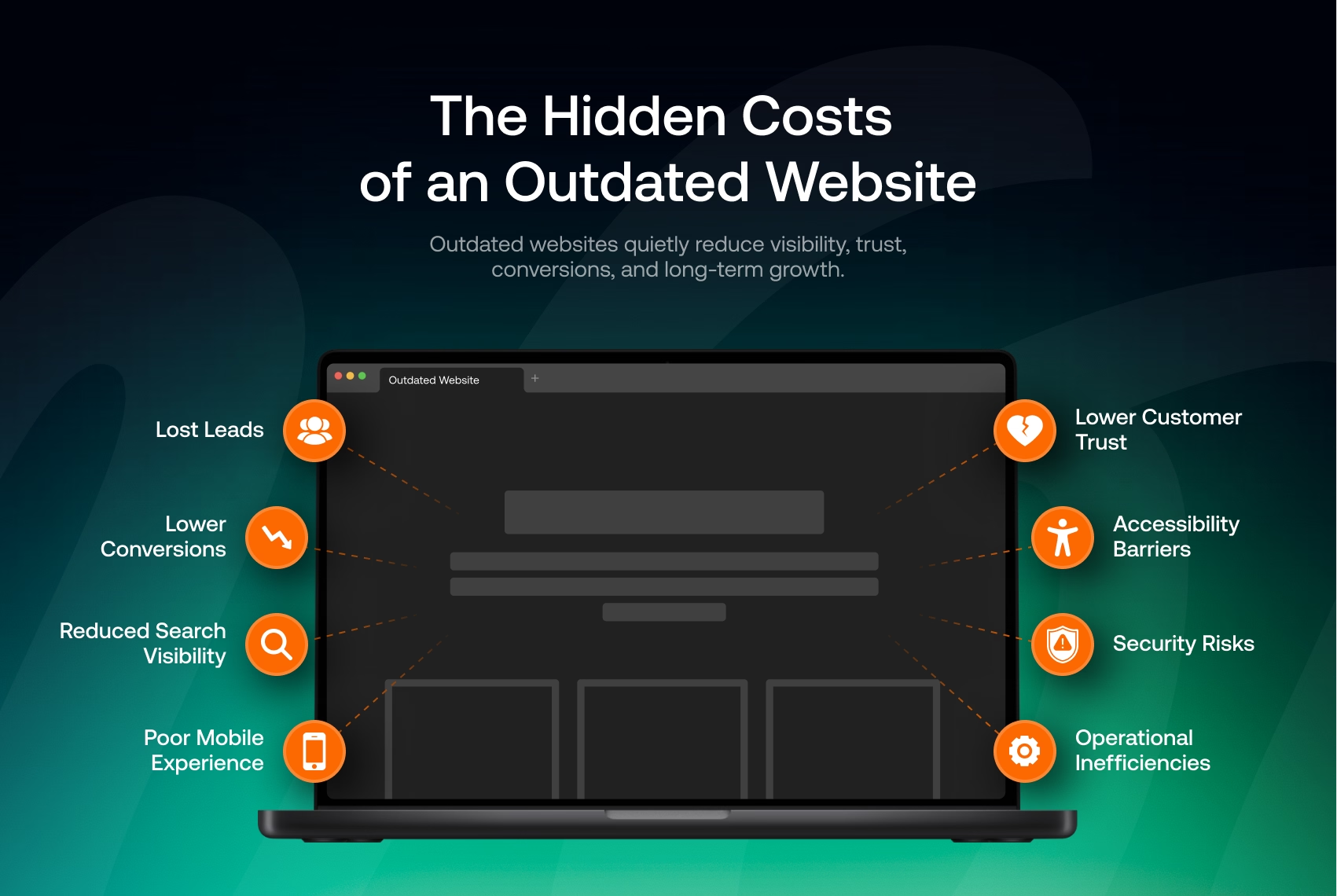
Lost leads, declining search visibility, poor user experiences, security risks, and missed conversion opportunities rarely appear on a financial statement. Yet together, they can significantly reduce business growth.
The good news is that these issues are often fixable.
A strategic website upgrade can improve website ROI, increase conversions, strengthen customer trust, and create a stronger foundation for long-term growth.
If your website no longer reflects your business, struggles to support marketing initiatives, or creates friction for customers, it may be time to evaluate whether it’s helping your growth goals or holding them back.
The cost of an outdated website extends beyond design. Businesses often lose revenue through lower conversion rates, reduced search visibility, weaker customer trust, security risks, and missed lead-generation opportunities.
An outdated website can reduce website ROI by creating friction throughout the customer journey. Poor user experience, slow load times, weak mobile performance, and declining SEO performance all contribute to lower returns from marketing efforts.
Accessibility improvements make websites easier to use for a broader audience. Better usability often leads to improved engagement, higher conversion rates, and stronger overall performance, which is why accessibility improvements can directly increase website ROI.
Common signs include declining traffic, low conversion rates, poor mobile performance, outdated design, difficult content management, high bounce rates, and increasing maintenance challenges.