Table of contents



A website can have excellent service pages, useful resources, strong case studies, and years of accumulated expertise, yet still make it surprisingly difficult for visitors and search engines to understand how everything fits together.
Often, the problem is the connections between those pages.
A deliberate internal linking strategy gives your website a clearer structure. It helps visitors move naturally from one question to the next, helps search engines discover and interpret your content, and gives AI search systems more context around the topics your business has expertise in.
For established businesses with dozens or hundreds of pages, internal linking becomes especially important. Years of publishing content, adding services, launching campaigns, and making incremental website updates can leave valuable pages buried several clicks deep or disconnected from the rest of the website.
Improving those connections can make existing content significantly more useful without requiring you to publish another hundred articles.
Generative engine optimization, or GEO, focuses on improving how clearly a business and its content can be understood, retrieved, and referenced by AI-powered search experiences.
Internal linking deserves more attention within that conversation.
Google has confirmed that its generative AI search experiences rely on the same foundational systems used by traditional Search. Its guidance for generative AI visibility specifically recommends maintaining a clear technical structure, keeping content crawlable, and making important content easy to find through internal links.
That makes internal linking for GEO less of a new tactic and more of an increasingly important application of a proven one.
Imagine a company has a comprehensive page about enterprise Webflow development services. Elsewhere, it has articles discussing Webflow migrations, CMS architecture, website scalability, technical SEO, and ongoing website maintenance.
If none of those pages connect to one another, each one has to establish its relevance largely on its own.
A thoughtful internal linking strategy creates relationships among them. The enterprise Webflow page can point to deeper resources when additional explanation is useful. Supporting articles can link back to the primary service page and to related resources.
The result is a network of content that provides substantially more context than a collection of isolated URLs.
This also improves the visitor experience. Someone researching a complex service rarely gets every answer from one page. Relevant internal links give them a logical next step, keeping them engaged with your business instead of sending them back to search results for the next piece of information.
For businesses investing heavily in content, this can be one of the highest-leverage opportunities available because the content may already exist. The missing piece is often structure.
Every website develops pages with different levels of authority and visibility.
Your homepage may attract backlinks. A research article might earn mentions from other websites. A case study may generate significant traffic. An older resource may have accumulated search visibility over several years.
Internal links allow those stronger pages to connect users and search engines to other relevant content.
Search engines use links to discover pages and understand relationships between them. Google specifically describes links as a signal for determining page relevance and recommends that every page you care about receive a link from at least one other page on your website.
This means your website link structure influences which pages appear central to the website and which ones are comparatively isolated.
Consider a high-value service page that is linked from the main navigation, referenced from several related case studies, and contextually linked from five relevant articles. Compare that with another service page accessible only through a dropdown menu.
The first page is surrounded by significantly more contextual information.
Internal linking should therefore reflect business priorities as well as content relationships.
If a service represents an important source of revenue, supporting content should naturally lead visitors toward it when appropriate. If a major resource explains a subject central to your expertise, related pages should reference it. If a case study provides proof for a claim on a service page, connecting those pages can help a prospective customer move from an assertion to evidence.
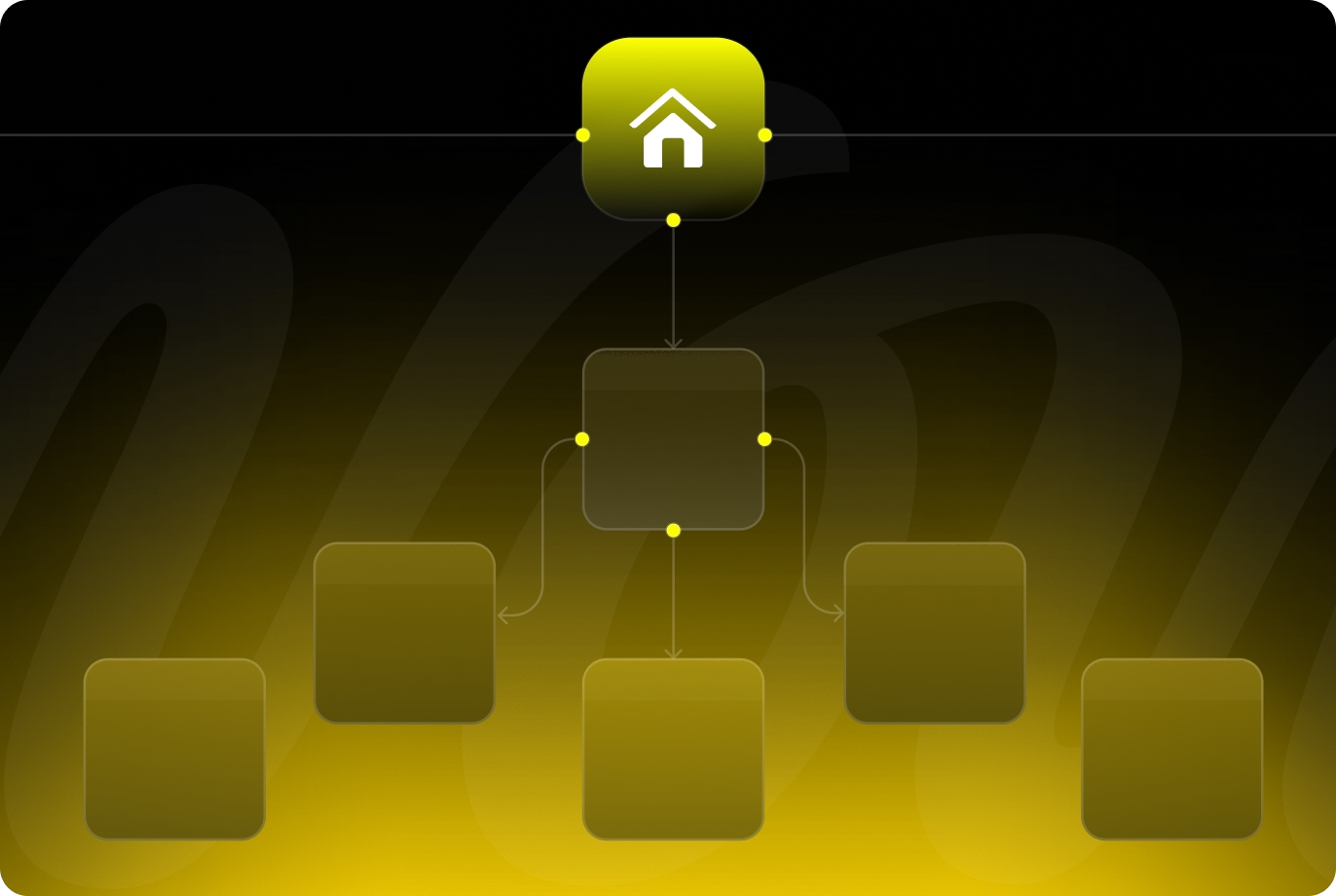
This is where site architecture and internal linking become closely connected. Architecture determines the overall hierarchy of information. Internal links reinforce that hierarchy while creating useful paths across it.
For the business, the benefit extends beyond rankings. Important pages become easier to discover, supporting information becomes easier to access, and visitors can reach decision-making content with less friction.
Topic clusters organize related content around a broader subject.
A business might have a central page about website redesign supported by resources covering website strategy, UX, SEO migrations, CMS planning, conversion optimization, accessibility, and performance.
Those pages have individual purposes, but together they demonstrate much broader coverage of the subject.
An effective internal linking strategy makes that relationship explicit.
The central page should link to supporting resources when they provide useful additional detail. Supporting pages should link back to the appropriate central resource and connect to other related pages when doing so genuinely helps the reader.
For example, an article about website migration planning might naturally reference a technical SEO resource. A technical SEO article might link to information about redirects. Both could connect back to a broader website redesign resource.
The goal is to create logical pathways based on how the topics actually relate.
This matters increasingly as search becomes more conversational. Google has explained that its AI search experiences can use "query fan-out," where a complex question leads to multiple related searches used to build a more comprehensive response.
A company with strong, interconnected coverage of a topic is better positioned for this kind of discovery than one with scattered articles that barely acknowledge one another.
Topic clusters also have a practical content strategy benefit. They reveal where coverage is genuinely missing.
Once you map the pages associated with a major service or subject, you may discover that the website answers eight parts of a customer's buying process extremely well but completely ignores the ninth. That gives your team a more useful publishing roadmap than choosing keywords individually.
It also helps prevent the opposite problem: publishing multiple pages that compete for essentially the same intent.
A well-planned cluster gives each page a clear job.
Good internal linking should feel natural to the person using the website. The technical benefit follows from creating connections that make sense.
A few internal links best practices are particularly important.
Anchor text is the clickable text attached to a link.
Generic phrases such as "click here" and "learn more" provide very little context. Descriptive anchor text tells a visitor what they can expect before clicking and gives search engines additional information about the destination page.
Google recommends anchor text that is descriptive, concise, and relevant to both the current page and the page receiving the link.
That does not mean every link pointing to your website redesign service needs the exact anchor text "website redesign services." Natural variations are usually more useful.
The surrounding sentence should make the link feel like part of the content rather than an SEO insertion.
A link inside a relevant paragraph generally carries more meaning for a reader than an unrelated link added to a large list at the bottom of the page.
If you mention the importance of preserving rankings during a redesign, that is a natural opportunity to link to a resource about SEO migrations.
The reader gets immediate access to more information at the exact moment it becomes relevant.
Navigation menus, footers, related-content modules, and breadcrumbs can all play important roles in your website link structure, but they should complement contextual internal linking rather than replace it.
Link depth describes how many steps someone has to take to reach a page from a major entry point, commonly the homepage.
Important content should not be buried unnecessarily.
This becomes a common problem as websites grow. A resource starts in the main navigation, gets moved into a resource library, then gets pushed to page four of an archive as new content is published. The URL technically still exists, but its connection to the rest of the website becomes weaker.
A shallow, logical structure generally makes important pages easier for both people and crawlers to find.
Adding 30 internal links to every article does not automatically make the website better optimized.
Each link should have a reason to exist.
Ask whether the destination helps the visitor understand the current subject, answer a likely next question, evaluate your company, or take a logical next step.
That standard tends to produce a healthier linking structure than arbitrary rules about the number of internal links each page needs.
For an established website, the first internal linking opportunity is often hiding in content that has already been published.
An internal link audit can reveal pages that receive few or no links, pages that receive links from irrelevant places, broken links, redirect chains, vague anchor text, and high-value pages that are poorly connected to supporting content.
Orphaned pages deserve particular attention.
An orphaned page has no meaningful internal path leading to it. It may still appear in an XML sitemap or be accessible through a direct URL, but visitors browsing the website are unlikely to encounter it naturally.
That is a problem when the page contains valuable content.
Start an audit by inventorying indexable URLs and identifying the internal links pointing to each one. Then compare those findings against the actual purpose and value of each page.
A page with very few internal links is not automatically a problem. A minor legal page and a major revenue-generating service page should not be treated identically.
The more useful question is whether the current linking structure accurately reflects the website's priorities.
Look for high-performing articles that could direct qualified visitors toward relevant services. Review service pages for opportunities to connect claims with case studies or deeper resources. Find older articles that should reference newer, more comprehensive content. Identify pages that cover closely related topics but currently exist in separate pockets of the website.
This is also an opportunity to remove unnecessary links.
A strong internal linking strategy is partly about deciding which relationships deserve emphasis. If every page points indiscriminately to everything else, the structure becomes less useful to visitors and harder to interpret.
For a growing business, periodic audits prevent years of website expansion from gradually turning a once-logical architecture into a maze, one of the less visible parts of the real cost of an outdated website.
SEO and GEO are often discussed as though businesses now need two completely different optimization strategies.
Current search engine guidance suggests considerably more overlap.
Google states that the SEO practices used to make content accessible, helpful, and understandable remain relevant to its generative AI features. To be eligible as a supporting link in Google's AI experiences, a page first needs to be indexed and eligible to appear in Search.
Bing has moved in a similar direction. Its Webmaster Tools now includes AI visibility reporting that can show how website URLs are cited across AI-generated experiences.
The underlying business implication is important: internal linking for GEO should strengthen the fundamentals of your website rather than distract from them.
Internal links support discovery. Search engines need to find a URL before they can index and retrieve it.
They provide context. Descriptive links help clarify what another page contains and how it relates to the current topic.
They reinforce topical relationships. A well-connected collection of pages gives crawlers a clearer picture of the subjects your website covers in depth.
They improve human navigation. Visitors arriving from traditional search or an AI-generated answer may land deep within your website. Internal links help them understand where they are and where they should go next.
That final point is easy to overlook.
Visibility is useful when it leads somewhere.
If an AI platform cites one of your educational articles and a qualified prospect clicks through, the website now has to turn that isolated visit into a meaningful journey. Relevant internal links might lead that person to a related case study, such as our Velocity on Canvas website project, a deeper resource, or the service responsible for solving the problem they were researching.
The value of the internal linking strategy therefore continues after the initial discovery. It can influence how effectively search visibility turns into actual business interest.
A website redesign is one of the best opportunities to improve internal linking because the work can begin with the architecture itself.
During a redesign, teams are already evaluating pages, navigation, content hierarchy, user journeys, URLs, and conversion paths. Internal linking can be planned alongside those decisions.
You can determine which pages serve as primary topic hubs, which resources support each service, where case studies belong in the journey, and how visitors should move between educational and commercial content.
You can also identify content that should be consolidated, redirected, rewritten, or removed before the new website launches.
Retrofitting an internal linking strategy afterward is possible, but it is often more labor intensive.
By that point, the navigation has been finalized. CMS collections have been built. Page relationships may already be constrained by the development approach, and content may have been migrated without considering how individual URLs fit into the broader information architecture.
This can leave a business paying to correct structural problems shortly after paying for a new website.
Planning site architecture and internal linking together also creates opportunities for more scalable solutions. A well-designed CMS, for example, can support relevant resources, associated services, related case studies, or topic relationships without requiring the marketing team to manually rebuild those connections every time new content is published. It is one of the main reasons to choose a Webflow development agency that plans CMS structure from the start.
That matters as the website grows.
A 20-page website can survive a lot of manual management. A website with hundreds of resources, services, locations, industries, case studies, and landing pages needs a system.
This is why website strategy before design is so important. The visual experience is only one layer of a successful redesign. The underlying structure determines how easily users can navigate the website, how efficiently teams can manage it, and how clearly search and AI systems can understand the content it contains.
A strong internal linking strategy creates clearer paths through the information your business has already invested in producing.
It helps search engines discover important pages. It reinforces relationships between services and supporting expertise. It gives AI search systems clearer, crawlable connections across related content. Most importantly, it helps real visitors continue their research without repeatedly leaving your website to figure out what to do next.
As websites grow, those relationships become increasingly difficult to manage accidentally.
If your current website link structure has developed over years of adding pages, blogs, services, and campaigns, a redesign is an opportunity to reconsider the system behind it.
Our free website redesign checklist can help you evaluate the broader pieces that should be addressed before rebuilding, including content, SEO, architecture, performance, and conversion paths.
And if organic search, GEO, content strategy, and website performance need to work together more intentionally, our digital marketing services are built around improving how those pieces support the broader goals of the business.
WowHouse Studio designs and builds Webflow websites with this structure in mind. Meet the team behind WowHouse, or talk to us about your website project.
An internal linking strategy is a deliberate plan for connecting pages within the same website. It determines which pages should link to one another, how those links are placed, what anchor text they use, and how the connections support user navigation, search engine discovery, and the overall hierarchy of the website.
For businesses, a good strategy helps visitors find relevant information and makes high-value services, resources, and conversion pages easier to discover.
Internal linking for GEO helps create clear relationships between related pages and makes important content easier for crawlers to discover. AI-powered search experiences frequently depend on search indexes and retrieval systems to find information used in generated responses, so crawlability, content organization, and traditional SEO fundamentals remain important.
Internal links alone cannot guarantee an AI citation, but they contribute to a website structure that makes content easier to discover and interpret.
There is no universal number of internal links that every page should contain. The appropriate number depends on the length of the content, the subject, and how many genuinely relevant resources exist elsewhere on the website.
Prioritize useful, contextual links instead of trying to meet an arbitrary quota. Every link should help the visitor understand the topic, answer a related question, evaluate the business, or reach an appropriate next step.
The most important internal links best practices include using descriptive anchor text, linking to relevant pages in context, ensuring important pages receive internal links, avoiding unnecessary link depth, fixing broken links and redirect chains, and regularly reviewing the website for orphaned content.
Internal linking should also reflect business priorities. High-value service and conversion pages should have clear, relevant paths leading to them.
An orphaned page is a page with no meaningful internal links pointing to it from elsewhere on the website. It may still be accessible through its URL or included in a sitemap, but users and crawlers have fewer natural paths for discovering it.
Orphaned pages are particularly concerning when they contain important services, resources, case studies, or other strategically valuable content.
Internal linking can support AI search visibility by improving crawlability, contextual relationships, and overall website structure. Google specifically recommends making content easily findable through internal links as part of its guidance for appearing in AI search features.
However, an internal linking strategy is only one component of GEO. Content quality, relevance, technical accessibility, authority, freshness, and other search signals also influence whether a page is retrieved or cited.
Yes. Planning site architecture and internal linking during a redesign allows page hierarchy, navigation, topic clusters, CMS relationships, conversion paths, and content migration decisions to be considered together.
Internal linking can be improved after launch, but incorporating it during website strategy usually creates a more scalable structure and reduces the amount of manual retrofitting required as the website grows.
There is no fixed schedule that applies to every website. Businesses that publish frequently or regularly add services, locations, case studies, or resources should review internal links more often than relatively static websites.
At minimum, an internal link audit is valuable during major SEO audits, content strategy reviews, and website redesigns. It is also worth reviewing internal links whenever substantial amounts of new content are added or the website architecture changes.