Table of contents



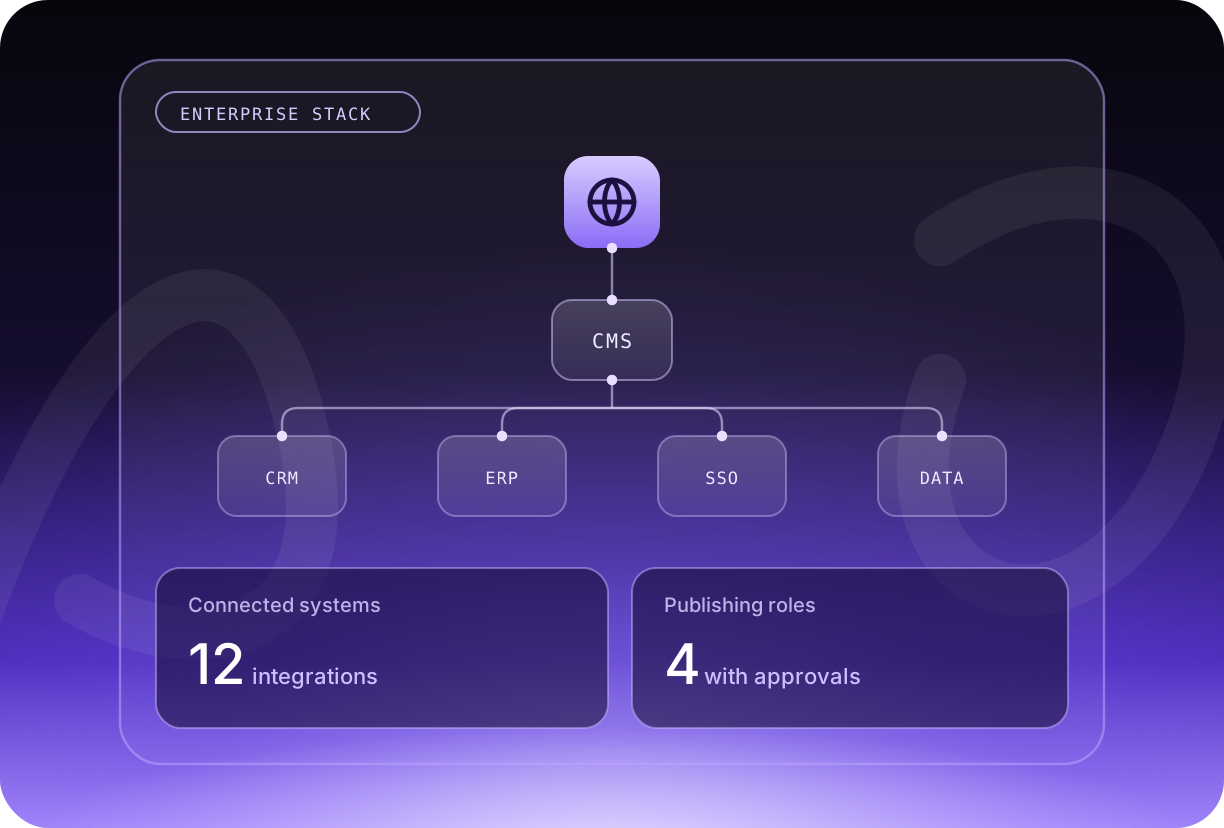
As businesses grow, their websites often become responsible for far more than introducing the company and generating leads. Marketing teams need to publish content independently, sales teams depend on CRM integrations, customers expect personalized experiences, and leadership needs confidence that the website can support future growth.
Eventually, the limitations of a conventional website can become a meaningful operational challenge.
So, what is an enterprise-level website, and when does a business actually need one?
An enterprise-level website is a digital platform designed to support complex business requirements, including large content libraries, multiple audiences, sophisticated integrations, advanced security, and collaboration across departments. While these websites are often associated with large corporations, enterprise-level functionality is determined more by operational complexity than company size.
Understanding these distinctions can help businesses make better decisions about website architecture, technology, development costs, and long-term scalability.
An enterprise-level website is a website built to support an organization’s complex digital operations while maintaining performance, security, consistency, and flexibility as its needs evolve.
Unlike a conventional marketing website, an enterprise website may serve multiple departments, geographic regions, customer segments, or business units. It often connects directly to essential business systems and requires structured processes for managing content, permissions, and technical changes.
Consider a manufacturing company operating across several markets. Its website might need to accommodate hundreds of product pages, distributor information, regional service locations, technical documentation, and different content for commercial customers and consumers.
Marketing needs to update campaigns regularly. Product teams need accurate specifications. Sales teams need inquiries routed to the appropriate representatives. Meanwhile, IT needs to maintain security and control access.
The website becomes an important part of how the organization operates.
This is why enterprise website design involves more than creating an attractive interface. The underlying structure must accommodate the people, processes, and systems that depend on it.
An enterprise website also doesn’t necessarily need thousands of pages or millions of visitors. A relatively small website with complex integrations, strict security requirements, and multiple approval workflows may require a more sophisticated architecture than a much larger informational website.
The distinction comes down to what the website needs to accomplish and how reliably it needs to accomplish it.
Although enterprise websites vary considerably between industries, several characteristics commonly distinguish them from more straightforward business websites.
Enterprise organizations often manage substantial amounts of content across multiple teams.
A company might publish blog articles, case studies, product information, industry resources, employee profiles, and regional landing pages. Managing these assets individually becomes increasingly inefficient as the website grows.
A well-structured content management system allows teams to organize information into reusable content types and templates.
For example, a company with 200 product pages shouldn’t need to manually redesign every page when a product specification changes. A properly configured CMS can make those updates more consistent and manageable.
Content structure also influences SEO. Clear relationships between pages, consistent metadata, and organized content categories help search engines understand how information fits together.
Enterprise websites frequently serve audiences with different priorities.
A technology company might need to communicate with prospective customers, existing clients, investors, job applicants, and potential partners.
Each audience arrives with different questions and expectations.
Effective enterprise website design considers these journeys during information architecture and navigation planning. Visitors should be able to find relevant information without navigating through content intended for entirely different audiences.
This becomes particularly important when a company serves both businesses and consumers, operates across industries, or offers several distinct service lines. Our guide to B2B website design covers how to structure those journeys for business buyers.
Enterprise web development often involves connecting the website to existing technology.
Common integrations include customer relationship management platforms, marketing automation software, enterprise resource planning systems, customer portals, inventory databases, and analytics platforms.
These connections help information move between systems without requiring employees to repeatedly enter the same data.
For example, a website inquiry might automatically create a CRM record, assign a sales representative, and trigger an appropriate follow-up workflow. Well-built forms matter here, and our guide to form optimization for conversions explains how to get them right.
The business benefit extends beyond convenience. Reliable integrations can improve response times, reduce administrative work, and provide better visibility into how website activity contributes to sales.
Larger organizations need a way to maintain brand consistency while allowing individual teams to work efficiently.
Reusable design components, standardized page templates, and documented content guidelines help accomplish this.
Without these foundations, websites often become inconsistent over time. Different departments create their own layouts, messaging conventions, and navigation patterns, making the experience harder to maintain.
A scalable design system allows teams to publish within established standards while retaining flexibility for their specific needs.
Security becomes increasingly important as a website supports more business functions, handles sensitive information, or connects to internal systems.
However, enterprise security involves more than enabling HTTPS or choosing a reputable hosting provider.
Organizations need to consider how information is collected, where it is stored, who can access it, and how changes to the website are controlled.
Not everyone working on a website needs the same level of access.
A content editor may need permission to update articles, while a developer requires access to code and technical configurations. A marketing director might need to approve changes before publication.
Role-based permissions help organizations establish appropriate boundaries.
They also reduce the risk of accidental changes to critical functionality.
As more employees contribute to a website, informal publishing processes become difficult to manage.
Enterprise websites often benefit from structured workflows that define who creates content, who reviews it, and who authorizes publication.
Version history and activity logs can provide additional accountability.
These controls are especially valuable for organizations where inaccurate information could create financial, legal, or reputational consequences.
Depending on the industry and location, websites may need to support privacy, accessibility, or other regulatory obligations.
For example, organizations handling personal information may need to address applicable privacy laws and data retention requirements. Healthcare and financial services businesses may face additional considerations depending on the information and services involved.
Compliance requirements should be evaluated during planning rather than treated as a final launch checklist.
It’s also important to distinguish between a platform’s security certifications and the compliance of a particular website implementation. Using a platform with strong security controls doesn’t automatically make every website built on it compliant.
The website’s forms, integrations, data handling, accessibility, and operational processes still need appropriate review.
Website scalability refers to the ability of a website to accommodate growth without requiring disproportionate increases in cost, maintenance, or technical complexity.
That growth might involve more visitors, additional content, new markets, more contributors, or expanded functionality.
An enterprise website should be designed with these possibilities in mind.
A website that performs well under normal conditions may encounter problems during major campaigns, product launches, or periods of unusually high demand.
Enterprise hosting requirements may include content delivery networks, caching, monitoring, traffic management, and contractual availability commitments.
These capabilities help organizations maintain a reliable experience as usage increases.
Performance also affects business outcomes.
Slow pages can create friction for visitors, particularly on mobile devices or during conversion-focused interactions. When a website supports significant marketing investment, even relatively small performance problems can undermine campaign effectiveness. These web design optimization strategies show where to start.
Content growth creates a different set of challenges.
A website might begin with 30 pages and eventually expand to several hundred. Without thoughtful information architecture, navigation becomes harder to manage, internal linking becomes inconsistent, and content duplication becomes more likely.
A scalable content structure anticipates how new information will be organized.
This includes establishing content types, taxonomies, URL conventions, and relationships between pages.
The goal is to make expansion manageable without repeatedly restructuring the website.
One of the most overlooked aspects of website scalability is the amount of internal effort required to maintain the platform.
If publishing a new landing page requires several developer hours, the process may become a bottleneck as marketing activity increases.
Enterprise websites should make common tasks easier to repeat.
Reusable components, CMS templates, documented workflows, and appropriate permissions allow teams to work more independently.
Over time, these efficiencies can be more valuable than improvements to hosting capacity alone.
Choosing an enterprise CMS is one of the most consequential decisions in a website project.
The content management system determines how information is organized, who can update it, and how easily the website can evolve.
Several platforms can support enterprise requirements, although they approach content management differently.
Webflow is particularly relevant for organizations that prioritize custom design, marketing flexibility, and efficient content publishing.
Its visual development environment allows teams to build sophisticated websites while maintaining reusable components and structured CMS content.
Webflow also offers enterprise capabilities such as advanced permissions, publishing workflows, single sign-on, and expanded support options.
For many marketing-driven enterprise websites, this combination can reduce dependence on traditional development workflows for routine content and design updates. You can see a custom Webflow build in our Velocity on Canvas case study, and learn why choose a Webflow development agency for a project like this.
However, organizations with highly specialized applications or complex backend requirements should evaluate integration needs carefully.
WordPress offers extensive customization through its open-source ecosystem.
Its flexibility can be useful for organizations with specialized content requirements or established development teams.
However, enterprise implementations require thoughtful decisions about hosting, plugin management, security, maintenance, and governance.
The platform’s flexibility also means that implementation quality can vary considerably.
Contentful is an example of a headless CMS, which separates content management from the presentation layer.
This approach can be valuable for organizations publishing content across multiple websites, applications, and digital channels.
For example, a business might manage product descriptions centrally and distribute them to its website, mobile application, and other customer-facing systems.
Headless architecture provides considerable flexibility, but it often requires more specialized development resources.
Adobe Experience Manager and Sitecore are established enterprise platforms that support sophisticated content operations and digital experiences.
They may be appropriate for organizations with extensive personalization requirements, multiple brands, or complex governance needs.
However, their implementation and ongoing management can involve substantial investment and specialized expertise.
The best enterprise CMS depends on how the organization actually operates.
A business with a relatively straightforward marketing website and a large content library may benefit from a different platform than one managing customer applications, complex transactions, and content across numerous channels.
Before selecting a CMS, organizations should evaluate editorial workflows, integration requirements, security needs, internal technical resources, and long-term maintenance costs.
Choosing an unnecessarily complex platform can create operational burdens without delivering meaningful additional value.
The differences between enterprise and small business websites are best understood through their operational requirements.
A typical small business website might include a homepage, service pages, an about page, and a contact form. One or two people may manage updates, and integrations might be limited to analytics, scheduling, or basic CRM functionality.
An enterprise website may support numerous departments, multiple audiences, extensive content libraries, and connections to business-critical systems.
The differences generally become most visible in four areas.
Importantly, these distinctions aren’t absolute.
A growing business may require enterprise-level functionality in one area while maintaining relatively straightforward requirements elsewhere.
For example, a company might need advanced CRM integration and structured content management without requiring a complex enterprise hosting agreement.
Recognizing these differences can help businesses invest in the capabilities they actually need.
Enterprise website costs vary substantially because the requirements behind these projects are rarely identical.
A content-focused corporate website with a few integrations involves a different level of effort than a multilingual platform connected to several internal systems.
For preliminary budgeting, businesses might encounter the following broad project ranges:
These figures are illustrative planning ranges, not fixed market prices or published industry averages. Some enterprise projects fall outside them entirely.
Several factors have a particularly significant impact on development budgets.
The initial development investment represents only part of the total cost of ownership.
Businesses should also budget for hosting, software subscriptions, maintenance, security reviews, integrations, content operations, and ongoing improvements.
Some platforms require specialized development teams for routine changes, while others allow marketing departments to manage more work independently.
These differences can meaningfully influence long-term expenses.
When evaluating proposals, businesses should consider both the initial project cost and the resources required to operate the website over the next several years. It also helps to understand why boutique agencies are often better than big ones when you want senior attention without enterprise-agency overhead, and how to choose the right Webflow agency if Webflow is on your shortlist.
A lower development quote may become less attractive if the resulting website is difficult or expensive to maintain.
Determining whether your business needs an enterprise-level website starts with evaluating the limitations of your current platform.
A website that still supports the organization’s requirements may not need a complete architectural overhaul.
However, certain recurring challenges suggest that a more sophisticated approach could be worthwhile.
Your business may be ready for an enterprise website if:
These challenges don’t automatically mean that your business needs the most expensive enterprise platform available.
In some cases, improving the CMS structure, redesigning the information architecture, or rebuilding the website on a more appropriate platform may resolve the underlying problems.
The important first step is understanding which limitations are genuinely affecting business performance.
Before evaluating platforms or requesting development proposals, document how the website is currently used.
Identify who manages content, which systems depend on the website, where internal processes create delays, and what the organization expects to accomplish over the next several years.
This exercise often reveals that the most important requirements aren’t immediately visible on the existing website. It’s the same discovery work that starts our process.
A company might initially request a more modern design, only to discover that its biggest challenge is an inefficient publishing process or poorly structured content.
Addressing those issues during planning can produce a website that is easier to manage and better equipped to support growth.
An enterprise website should provide enough flexibility to accommodate future requirements without introducing unnecessary complexity today.
That balance requires thoughtful decisions about architecture, content management, integrations, and ongoing ownership.
For established businesses, the goal is to create a website that supports marketing, sales, and operations while remaining manageable for the people responsible for it.
At Wow House Studio, we approach custom website design and Webflow development with these long-term considerations in mind. We help businesses evaluate their current limitations, establish a stronger website strategy, and build experiences that support both their customers and internal teams. You can learn more about our team and how we work.
If your current website is becoming difficult to manage or no longer supports your organization’s goals, a strategic evaluation can help determine whether an enterprise-level approach is the right next step. Get in touch to talk it through.
An enterprise-level website is a digital platform designed to support complex organizational requirements, including multiple audiences, extensive content management, advanced integrations, security controls, and scalable infrastructure. Its defining characteristic is operational complexity rather than company size.
Enterprise websites typically require more sophisticated content management, integrations, permissions, governance, and scalability. Standard business websites generally have fewer contributors, simpler functionality, and less demanding operational requirements.
Enterprise website development can range from tens of thousands to several hundred thousand dollars or more. The cost depends on design complexity, integrations, content migration, security requirements, and the amount of custom development involved.
No. A website with relatively few pages may still require enterprise-level architecture if it supports complex integrations, multiple teams, strict governance, or specialized functionality.
An enterprise CMS is a content management system designed to support complex publishing requirements, including structured content, multiple contributors, advanced permissions, integrations, and content distribution across teams or channels.
Yes. Webflow offers enterprise capabilities designed for organizations requiring advanced collaboration, governance, security, and scalable content management. Whether it’s the right platform depends on the organization’s technical and operational requirements.
Development timelines vary significantly. A relatively straightforward enterprise website might take several months, while projects involving extensive integrations, content migration, and stakeholder coordination can require six months to a year or longer.
A scalable enterprise website uses flexible content architecture, appropriate infrastructure, reusable components, efficient workflows, and integrations that can accommodate growth without requiring extensive rebuilding.
Some do, particularly when their website supports complex operations or multiple teams. However, many growing businesses can meet their needs with a thoughtfully structured custom website without investing in a full enterprise platform.