Table of contents



Launching a new website gives your business a stronger foundation for growth, but that foundation still needs attention as your company evolves. New services are introduced, teams change, content gets added, search behavior shifts, and the technology connected to your website changes over time. A strong website maintenance strategy helps make sure the website continues supporting the business you have today, rather than slowly becoming a reflection of where the company was when it launched. At Wow House Studio, we've seen firsthand how quickly an unattended website can fall behind the business it's supposed to represent.
For growing businesses in particular, ongoing maintenance protects the investment you've already made in your website. It gives your team a process for catching technical problems early, keeping important content accurate, protecting organic visibility, and identifying opportunities to improve performance as more data becomes available. If you're unsure whether your current site is keeping pace, our guide on the real cost of an outdated website outlines exactly what's at stake when maintenance is skipped.
A website launch is based on what you know at that moment: your current audience, services, positioning, content, conversion paths, and available performance data.
Six or twelve months later, some of those things will probably be different.
You may have launched a new service. Your sales team may be hearing different questions from prospects. A case study might now be one of your strongest sales assets. Analytics may show that visitors behave differently than expected. Pages that originally performed well in search may begin losing visibility, while others emerge as opportunities. Whether you're working with a boutique Webflow development studio or managing your site in-house, this drift happens to every business.
Post-launch website maintenance creates a regular process for responding to those changes. If you're not sure what that process should look like for your team, contact Wow House Studio and we can walk through a practical plan together.
It also helps protect the technical health of the website. Links can break, integrations can stop working correctly, content additions can affect page speed, and changes elsewhere on the website can unintentionally create SEO or usability problems.
For businesses that rely on their website for lead generation, those aren't simply website issues. They can directly affect how easily prospects find you, evaluate your company, and ultimately become customers. Look at what happened with our work for Velocity on Canvas: consistent post-launch attention to content and performance helped the site continue performing long after the initial build was complete.
A useful maintenance strategy can generally be divided into four areas: technical health, content, SEO, and security. Understanding who you're working with matters here too. Whether you've partnered with a full-service Webflow development agency or a freelance developer, the maintenance responsibilities on the business side remain the same.
Technical maintenance focuses on whether the website continues functioning the way it should.
That includes monitoring:
Performance deserves particular attention because it can change gradually. A website might launch with excellent performance and become slower over time as teams upload oversized images, add scripts, install integrations, or build new sections. This is one of the reasons businesses choose a Webflow development service over heavier CMS platforms: the performance baseline is cleaner and easier to maintain.
Google's Core Web Vitals measure real-world loading performance, responsiveness, and visual stability through Largest Contentful Paint (LCP), Interaction to Next Paint (INP), and Cumulative Layout Shift (CLS). Google recommends good Core Web Vitals both for user experience and search performance.
Your website should keep pace with your business. That means periodically reviewing service descriptions, team information, pricing where applicable, portfolio work, case studies, statistics, certifications, client logos, and other credibility signals. To understand more about who we are and how we approach this for clients, visit our about page.
This is especially important for growing companies. A website can undersell the business surprisingly quickly.
Imagine a company launches its website when its largest customer is worth $50,000. Two years later, it's routinely handling $500,000 engagements, but the website still showcases the same small projects and positioning. What digital marketing agencies typically offer small businesses includes content strategy, performance auditing, and positioning reviews — exactly because this problem is so common.
The website may function perfectly. The problem is that prospects are evaluating a version of the company that no longer exists. This is the kind of strategic drift that our custom website design service is built to prevent from the start, with scalable content architecture designed to grow alongside the business.
SEO performance also needs ongoing attention.
Google Search Console allows businesses to monitor queries, impressions, clicks, rankings, indexing, and technical search issues. It can also identify URLs Google isn't indexing and alert website owners when certain problems arise.
Regular SEO maintenance might include:
The goal is to understand what your search data is telling you and use it to determine where the next opportunity exists. For businesses evaluating what Webflow development services actually include from an SEO standpoint, our complete guide to Webflow development services covers how the platform handles technical SEO natively.
A blog that consistently generates qualified traffic may deserve supporting articles. A service page sitting just outside the first page of search results may warrant additional optimization. An important page losing traffic may need to be refreshed.
Maintenance turns SEO into an ongoing source of information about what your market is looking for. This is part of what separates the best Webflow agency relationships from transactional build-and-hand-off arrangements — continued partnership drives continued results.
Security responsibilities vary significantly depending on how a website is built and hosted.
For example, Webflow site maintenance doesn't require businesses to manually install platform security patches or manage traditional server updates. Webflow provides managed hosting, SSL provisioning, and infrastructure security, which removes some of the maintenance burden associated with other website platforms. You can explore how this compares to alternative platforms in our breakdown of why to choose a Webflow development agency.
There are still security responsibilities on the business side. Webflow recommends practices including strong passwords, two-factor authentication, protecting account credentials, and verifying domain ownership.
You should also periodically review who has access to your website and connected platforms. Former employees, contractors, or agencies shouldn't retain access indefinitely after they stop working with your company. This applies whether you're working with a large Webflow design and development service or a smaller boutique studio.
Not every maintenance task needs to happen every month. Creating separate monthly and quarterly routines makes maintenance much easier to manage. We've also compiled a range of planning resources in our freebies section for businesses that want to build a more structured internal process.
Once a month, review the areas most likely to affect leads, performance, and visibility:
This doesn't need to become an enormous monthly project. The purpose is to catch changes before they have months to compound.
Every quarter, step back and evaluate the website more strategically. If you're considering whether an ongoing support arrangement makes sense, our pricing page outlines what that looks like with Wow House.
This is also a good opportunity to compare website performance against the previous quarter rather than evaluating individual metrics in isolation.
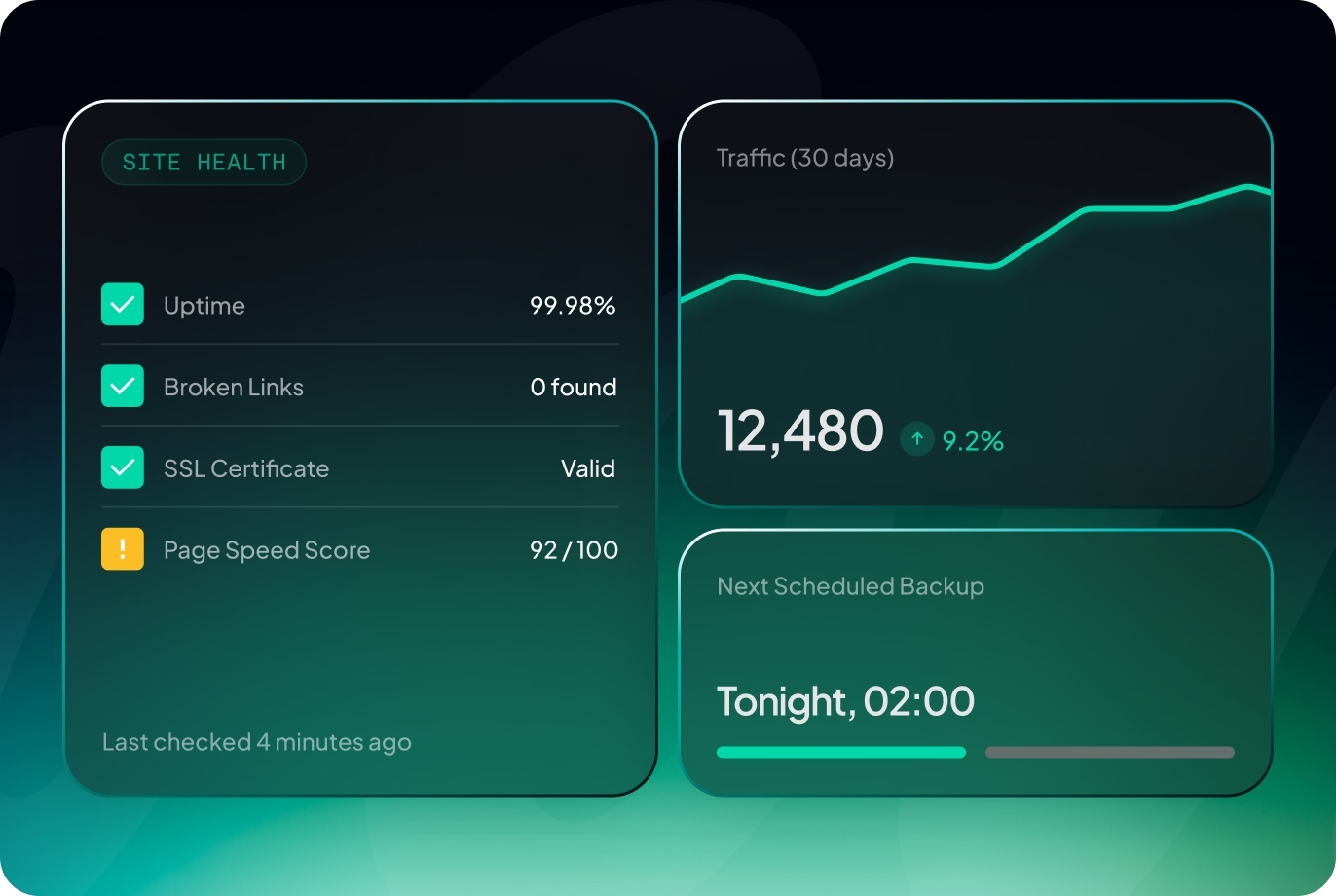
Three areas deserve consistent monitoring because problems can develop without being immediately obvious: performance, availability, and links.
Google recommends monitoring Core Web Vitals through Search Console. Its Core Web Vitals report separates mobile and desktop performance and categorizes URL groups based on whether performance is good, needs improvement, or is poor.
You don't need to obsess over achieving perfect scores. Google itself advises against focusing on individual metrics purely for SEO purposes. The larger objective is providing visitors with a strong overall page experience. Understanding how to choose the right Webflow agency often comes down to whether the team you're considering treats performance as an ongoing responsibility or a one-time launch checkbox.
Uptime monitoring serves a simpler purpose: knowing when your website becomes unavailable so the problem can be addressed quickly.
Broken-link monitoring is similarly straightforward. Websites naturally accumulate broken links as pages move, resources disappear, URLs change, and content evolves. Regularly identifying and correcting those links improves the experience for visitors and helps maintain a clean website structure.
One of the highest-value maintenance activities often has very little to do with technology.
Update your proof.
For many B2B and service businesses, prospects visit the website specifically to answer questions like: Have they done this before? Do they work with companies like ours? Can they actually deliver the result we're looking for?
Your case studies, portfolio, testimonials, client logos, certifications, performance data, and results help answer those questions. Brand strategy services — including positioning, messaging, and evidence architecture — should be reflected in how your proof is organized and presented. If you're thinking about how that fits into your broader marketing picture, our piece on brand strategy services explained covers the full scope of what that work includes and what it typically costs.
As your company improves, your website should become more convincing too.
If you've completed a project that is substantially better than something currently featured in your portfolio, replace it. If a customer achieved a significant result, turn it into a case study. If you've expanded into a new industry, make sure prospects in that industry can recognize themselves in your website.
This is website maintenance in one of its most valuable forms because you're improving the information prospects use to decide whether your business belongs on their shortlist.
Not every business needs an agency managing its website every month.
If your website is relatively simple, changes are infrequent, and someone internally understands your CMS, analytics, and basic SEO, much of the routine content maintenance can probably stay in-house.
Ongoing website support becomes more valuable when the website is actively contributing to growth.
That may be the case when:
The decision ultimately comes down to capability and opportunity cost.
If your marketing team can confidently manage the website without pulling attention away from higher-value work, keeping maintenance internal may make sense. If website work regularly requires outside expertise or keeps getting deprioritized, ongoing support from a Webflow design and development service can provide the capacity needed to keep improvements moving.
Website neglect is usually gradual.
A company rarely wakes up to a completely unusable website. Instead, small issues accumulate.
The team page has employees who left eight months ago. Several portfolio pieces are outdated. A form sends submissions to someone who changed roles. Mobile layouts have problems on newer pages. Blog posts link to resources that no longer exist. Organic traffic has been declining, but nobody noticed. New services aren't represented clearly. Analytics stopped tracking a conversion months ago.
Eventually, those small issues affect the website's credibility and performance.
Some of the clearest signs that it's time for a maintenance audit include:
If several of these sound familiar, a structured audit can help separate quick fixes from larger strategic problems.
A good website gives you something valuable after launch: data.
You learn which pages attract visitors. Which services generate interest. Which content earns organic visibility. Where prospects convert. Where they leave. Which questions repeatedly come up during sales conversations.
Regular website maintenance gives your business a chance to act on that information.
For a growing company, that means the website you launch today can become more useful over time as you learn more about your customers, strengthen your positioning, build better proof, and identify new opportunities. The best Webflow agency relationships aren't measured at launch — they're measured by what the site does twelve months later.
At Wow House Studio, we provide ongoing website support across strategy, UX and UI design, Webflow development, SEO, performance optimization, and continuous website improvements. If your website has fallen behind your business or you simply need a reliable team to keep it moving forward, contact Wow House Studio to talk through what ongoing support could look like for your team.
Important website functions should be monitored continuously, with a more structured review at least monthly. A deeper strategic review every quarter can help identify opportunities related to content, SEO, UX, conversions, and changing business priorities.
Website maintenance can include technical monitoring, content updates, SEO, broken-link checks, Core Web Vitals monitoring, form testing, analytics verification, security reviews, CMS updates, integrations, and ongoing design and development improvements. What digital marketing agencies typically offer small businesses includes all of these functions, either bundled into a retainer or scoped as individual services.
Yes, although Webflow handles several infrastructure responsibilities that require manual maintenance on other platforms. Webflow provides managed hosting, SSL, and automatic site backups, but businesses still need to maintain their content, SEO, integrations, analytics, user access, performance, and website experience over time. Webflow automatically creates backup restore points as you work, and paid Site plans currently provide unlimited backups.
At minimum, check forms, broken links, analytics, Search Console, organic performance, Core Web Vitals, important integrations, high-value pages, and any content added during the previous month.
Ongoing support usually makes sense when the website plays an important role in lead generation or marketing and the internal team lacks the time or specialized design, development, SEO, or optimization resources needed to maintain it consistently. Whether you're evaluating a Webflow development agency, a digital marketing partner, or a combined Webflow as a service arrangement, the key question is whether your current setup allows you to act on what your website data is telling you.