Table of contents



As your business grows, your website should make it easier to launch new services, publish content, improve search visibility, and convert visitors into customers. None of that happens by accident. It starts with a scalable website architecture that supports both your current goals and future growth.
Many businesses do not think about website architecture until problems begin to surface. New pages become difficult to organize, navigation grows cluttered, important content struggles to rank, and simple updates require more time than they should. Over time, these issues slow marketing efforts, limit SEO performance, and create unnecessary work for internal teams.
A thoughtful website structure solves these challenges before they become obstacles. It helps search engines understand your content, guides visitors toward the information they need, and creates a foundation that can expand alongside your business without requiring constant reorganization.
This is also one of the most important considerations during any website redesign or relaunch. The decisions made during the planning phase about URL hierarchy, navigation, and content organization determine how much SEO equity the new site inherits and how easily it scales from that point forward. The website redesign checklist covers these structural decisions alongside the technical migration requirements that affect search performance during the transition.
In this guide we cover the principles behind scalable website architecture, explain how it improves long-term SEO performance, and share practical strategies for building a website that is prepared to support growth for years to come.
Website architecture refers to how your pages are organized, connected, and presented to both users and search engines.
A thoughtful structure helps search engines discover and index pages efficiently, helps visitors navigate your website naturally, allows authority to flow throughout the site, gives new pages a logical place within an organized hierarchy, and allows future expansion to happen without disrupting existing content.
Businesses consistently underestimate how difficult it becomes to reorganize a website after hundreds or thousands of pages already exist. Investing in a scalable structure early creates a stronger foundation for every marketing effort that follows, including SEO, content marketing, paid advertising, and conversion optimization.
This structural investment also pays dividends specifically in the context of website redesign SEO. One of the most common reasons a redesign damages organic performance is that the architecture changes without a clear plan for preserving the relationships between pages, URLs, and internal links. Businesses that approach a redesign with a documented content hierarchy and redirect map consistently recover faster and often emerge with stronger rankings than they had before.
A scalable website architecture is designed to support growth without requiring major structural changes every time the business evolves.
Instead of building only for today's needs, scalable architecture anticipates future additions such as new services, additional product categories, resource libraries, case studies, industry pages, location pages, blog content, and third-party integrations.
As your website expands, every new page should have a logical place within the existing hierarchy. That consistency benefits both users and search engines by creating predictable patterns that reduce confusion and improve crawl efficiency.
For businesses currently planning a redesign or migration, this is one of the foundational website redesign SEO considerations that should be resolved before design work begins rather than after. Retrofitting a scalable architecture onto a site that has already launched is significantly more disruptive and expensive than building it correctly from the start. The guide on how to redesign your website covers how to approach that planning sequence in detail.
Several principles guide effective website architecture consistently across industries and business types.
Simplicity: Users should never struggle to understand where they are or how to reach another page. Complexity in navigation and page organization creates friction that reduces both engagement and conversion.
Consistency: Navigation, page layouts, URLs, and content organization should follow predictable patterns throughout the entire website. Inconsistency creates cognitive load for users and confusion for crawlers.
Crawlability: Search engines should be able to discover every important page without encountering unnecessary obstacles such as orphan pages, broken links, or excessively deep navigation hierarchies.
Scalability: The structure should accommodate growth without requiring significant reorganization. Every architectural decision should be evaluated against where the business will be in 24 to 36 months, not just today.
User Intent: Every section of the website should align with what visitors are actually trying to accomplish at that stage of their journey. Structure should reflect how users think about your business, not how your internal team is organized.
Search engines discover content by following links throughout your website.
When pages are organized logically with strong internal linking, search engines can discover new content faster, understand relationships between related pages, determine the relative importance of different pages based on how many internal links point to them, and crawl the site more efficiently without wasting crawl budget on dead ends or redundant paths.
Poor architecture creates orphan pages with no internal links pointing to them, duplicate content paths that create cannibalization, and unnecessary crawl depth that buries important pages too far from the homepage to receive adequate authority.
The easier your website is to crawl, the easier it becomes to earn visibility. This is equally true for traditional search engines and for AI-powered answer systems that increasingly evaluate site structure as a quality and trustworthiness signal. A site with strong architectural clarity is better positioned to be cited by AI search systems, not just ranked by traditional algorithms.
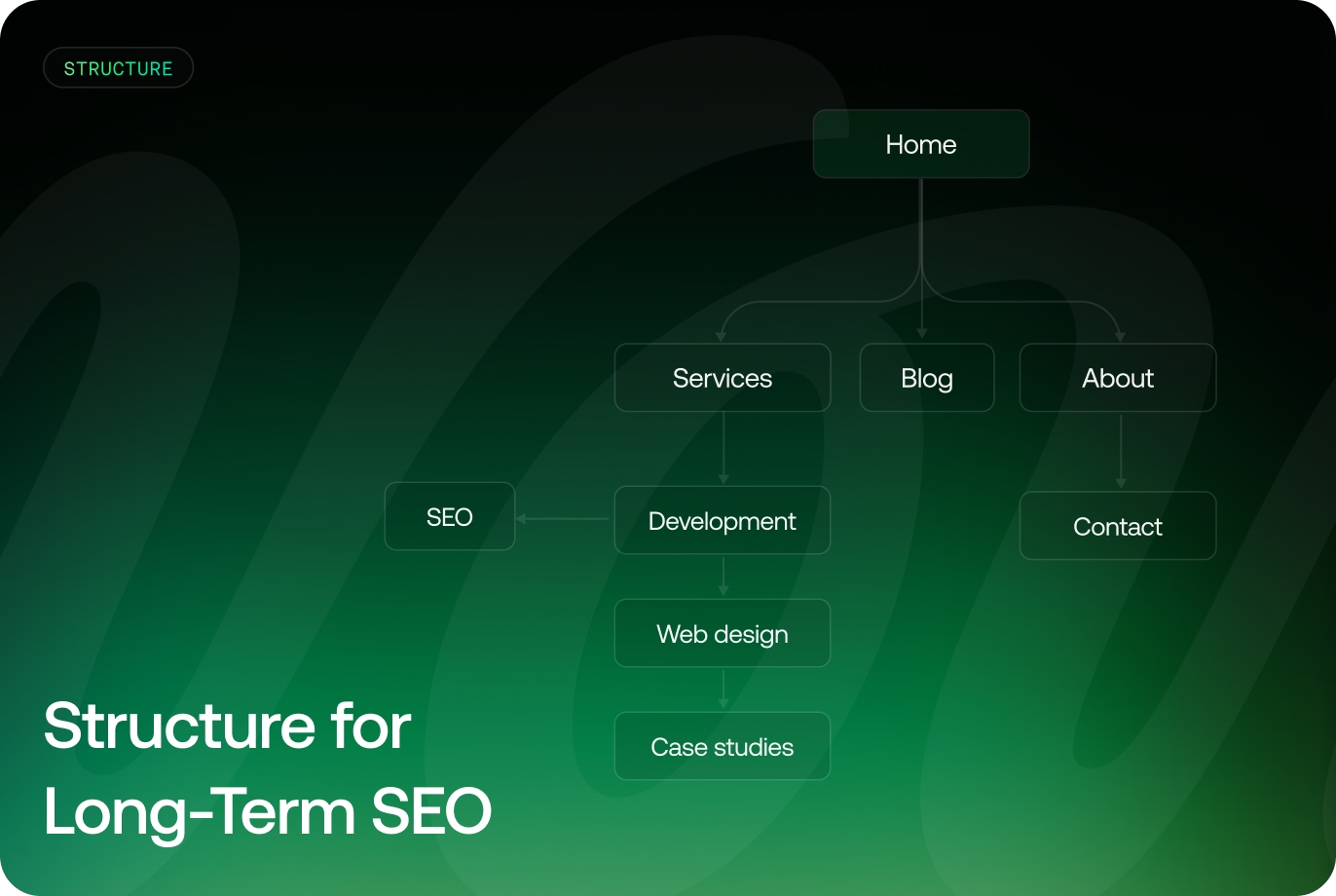
Think of your website like a tree with a clear root and predictable branching.
The homepage sits at the top. Core service or product categories branch directly from it. Individual service pages, case studies, and supporting blog content hang from those categories. Industry or location pages form parallel branches for businesses that serve multiple markets.
Every page should naturally belong within a larger category. Standalone pages that do not clearly fit into the overall hierarchy create structural debt that compounds as the site grows.
For businesses evaluating this structure for the first time during a redesign, the SEO checklist for website redesign should include a documented site map showing every existing page and where each page will live in the new hierarchy before a single development decision is made. The digital marketing and SEO services at Wow House Studio incorporate this mapping as a standard part of every project scope precisely because it prevents the structural problems that damage organic performance post-launch.